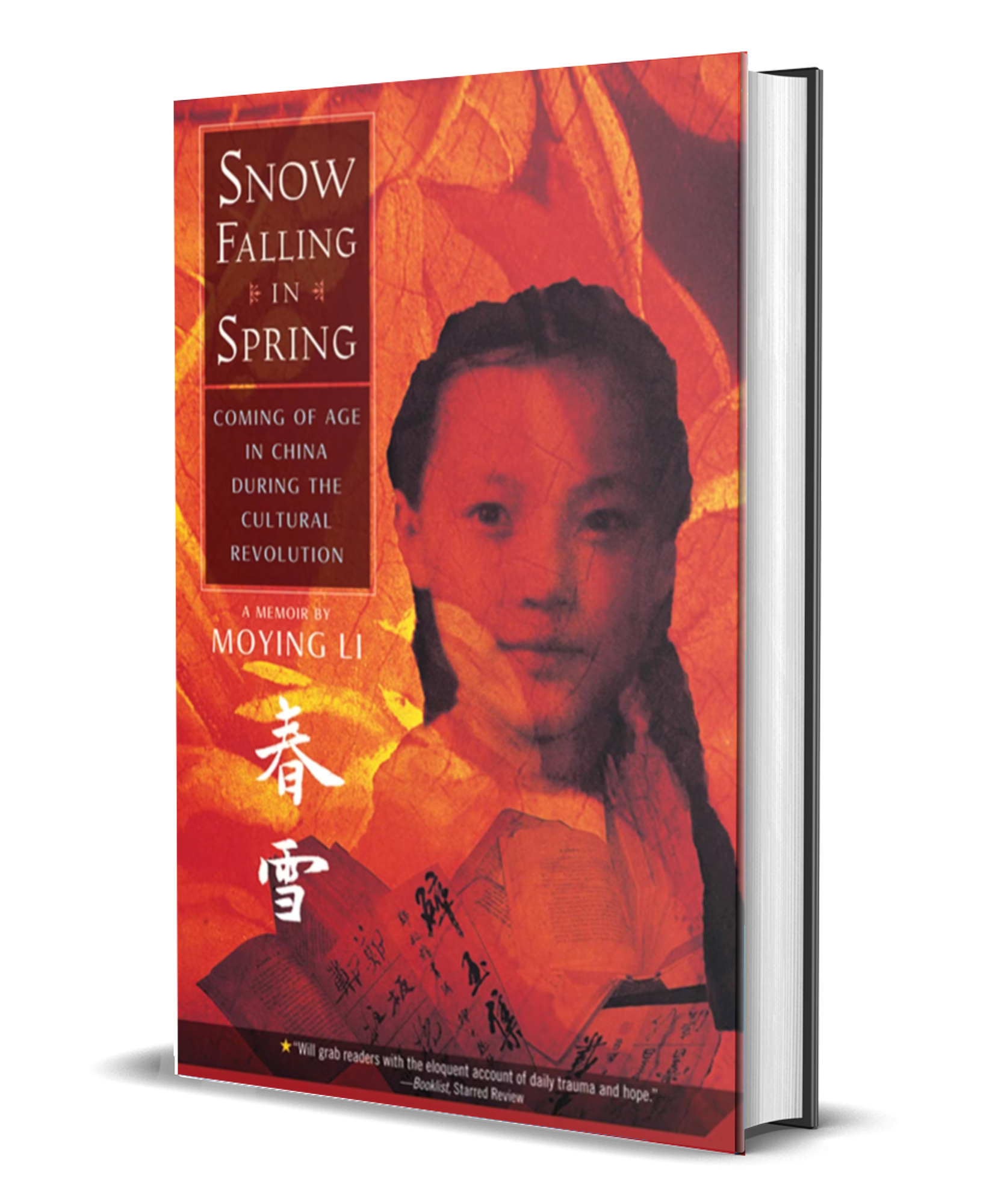
Snow Falling in Spring: Coming of Age in China during the Cultural Revolution
Moying Li is twelve years old when the Cultural Revolution sweeps across China. Studying in a prestigious language school in Beijing, she seems destined for a promising future. But everything changes when student Red Guards orchestrate brutal assaults, public humiliations, and forced confessions throughout the country.
After watching her headmasters beaten in public, Moying flees school for the safety of home, only to find her beloved grandmother denounced, her home ransacked, and her baba taken away—along with his precious books. Struggling to make sense of her crumbing world, she finds sanctuary in literature. But with many schools shut down and most books forbidden, how can she keep her passion for learning alive?
In spare, evocative prose, this inspiring memoir illuminates a dark time in China’s history as it tells the compelling story of one girl’s difficult but determined coming-of-age.
Reviews
"This is the story of the most turbulent time in modern China, seen through the eyes of a young girl. The writing flows like water – quiet but deep.”
— Hualing Nieh-Engle, winner of the American Book Award for Two Women of China
"This stirring memoir makes personal the history (of the Cultural Revolution) from the viewpoint of a child who is shocked into confronting betrayal and violence close to home. Raised in a loving extended family, Moying is just 12 years old in 1966, when her world is suddenly transformed. The stirring detail, with occasional black-and-white personal photos, stays true to the young girl’s viewpoint during the following 14 years, as Moying is sustained by her extraordinary grandmother, who includes friends, neighbors, and even some strangers in her family. The simple, direct narrative will grab readers with the eloquent account of daily trauma and hope.”
— Hazel Rochman, Booklist, Starred Review
"Simply and hauntingly told..."
"The World of young adult literature is rife with shallow troubles and what the singer Ben Folds calls 'unearned unhappiness.' Here is the real thing, a world upended and filled with horrors and viciousness. And yet the story is told without melodrama or pathos; instead, the even tone allows the terror to stand on its own. For many readers a little outside reading would help to place the story in its historical context, but they will be gripped by it either way. At its essence, this is a book about the value of reading-- to escape, to learn, to be sustained and to grow."
— John Schwartz, The New York Times Sunday Book Review
"Born in Beijing, Li was a child through the most cataclysmic events of China's modern history. She was 4 in 1958 when the "Great Leap Forward" attempted to yank China from an agrarian to industrialized economy... 'I am trying to provide people with a window to look into that historic period without judgment on my part,' she said. 'That's why I chose to write it from the beginning as a child who could not judge.'"
— Dana Bisbee, The Boston Globe
"This memoir offers a highly personal look at China's Cultural Revolution. The author is four years old when Mao initiates the Great Leap Forward in 1958, and she describes the transformation of the family's shared, once lovely courtyard as the neighbors follow orders to erect a brick furnace and feed it all their metals in an attempt to produce iron and steel. Everyone, including the child nattator, willingly cooperates, but the instructions are flawed and everything is ruined. Li effectively builds the climate of fear that accompanies the rise of the Red Guard, while accounts of her headmaster's suicide and the pulping of her father's book collection give a harrowing closeup view of the persecution. Sketches about her grandparents root the narrative within a broader context of Chinese traditions as well as her own family's values, establishing a basis for Li's later portrayal of the individuals around her who respond to oppression with hope and faith in knowledge and education. Black and white family photos reinforce the intimate perspective."
— Publisher's Weekly, Starred Review
"... reading this book, while you recount many dreadful events that happened during the Cultural Revolution, your feelings are not bleak. 'I agree with the Daoist philosophy. The world is like two sides of the same rice paper. While the Cultural Revolution brought pain and suffering, both good and bad happened. We've had 30 years now to mourn and transcend it. Without it China would not have matured. We've been able to distill valuable lessons and go beyond it.'"
— The Beacon Hill Times
" From 12 to 22, Moying Li witnessed... city dwellers and intellectuals sent to the countryside for forced farm labor; marauding Red Guards. Her school headmaster hanged himself. But she survives to become one of the first Chinese students to study in the U.S. and now lives in Boston. She tells the story with simple eloquence."
— New York Post, Required Reading
" In her engaging memoir of growing up in China, Li tells the story of her family's efforts first to follow with enthusiasm Chairman Mao's dictates and then to comply with them despite disillusionment and fear.... This beautifully written memoir joins a growing body of literature about life in China during the Cultural Revolution. Because the book starts with the Great Leap Forward and extends beyond the end of the Cultural Revolution, it offers a somewhat broader view of a nation in turmoil and illustrates the grit and determination necessary for survival in a dysfunctional society."
— School Library Journal